
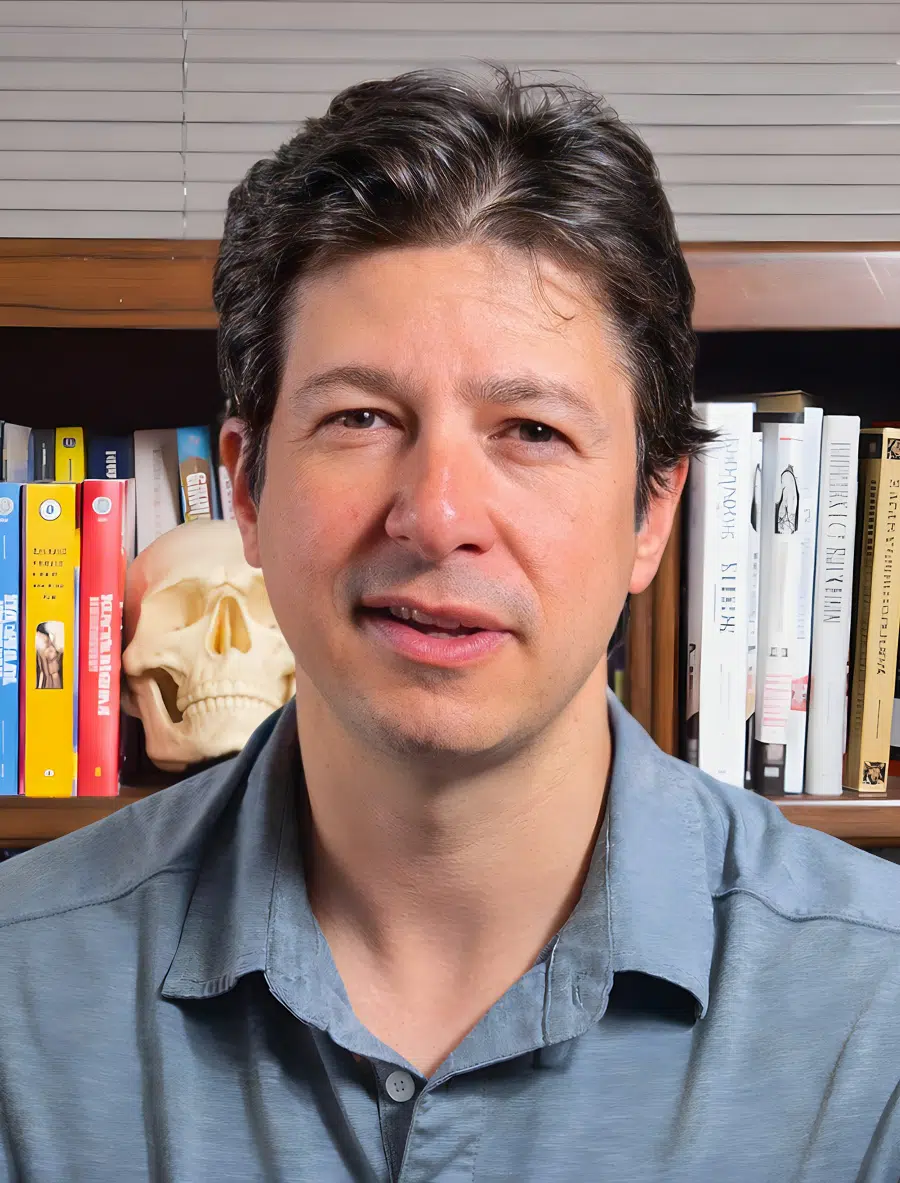
I’m a neurosurgeon in Orange County, California. I operate on spines and brains, and I spend a lot of time trying to help people avoid both.
That second part isn’t a throwaway line. A large portion of my practice is patients who’ve been told they need a spinal fusion and don’t, or patients who’ve already had surgery that didn’t work. Failed back surgery syndrome is one of the most common and least talked-about problems in spine care. I see it every week. Treating it well requires a different set of tools than most spine surgeons carry — which is why I trained specifically in neuromodulation.
Training
I went to medical school at Johns Hopkins and did my neurosurgery residency at USC, where I trained in brain and spine surgery, including minimally invasive techniques. After residency, I completed a fellowship at Ohio State in neuromodulation and functional neurosurgery, a subspecialty focused on using electrical stimulation to treat chronic pain and movement disorders like Parkinson’s Disease and Essential Tremor.
That fellowship shaped how I practice. I was one of the first surgeons in Southern California to implant the Nevro Senza spinal cord stimulator. I pioneered single-stage asleep deep brain stimulation in Orange County, which lets patients undergo the entire DBS procedure under general anesthesia in one session instead of two. I was the first in Orange County to offer DBS for epilepsy. I’m trained on devices from Abbott, Boston Scientific, and Medtronic, which means I can match the device to the patient rather than fitting every patient to the one device I happen to carry.
Philosophy
I believe many patients get operations they don’t need. The spine surgery world has a volume problem: the incentive is to operate, and not every surgeon has alternatives to offer when surgery isn’t the right call. I do. Between minimally invasive approaches, motion-preserving disc replacement, spinal cord stimulation, and restorative neurostimulation for the multifidus muscle (ReActiv8), I can usually find something that fits the patient’s actual problem rather than the problem that’s easiest to bill for.
When surgery is the right answer, I want it to be the smallest effective surgery. Most of my spine patients go home the same day. I don’t do that because it’s a marketing point: I do it because less tissue disruption means faster recovery, and faster recovery means patients get back to their lives.
What I treat
Spine: herniated discs, spinal stenosis, degenerative disc disease, spondylolisthesis, failed back surgery syndrome, cervical myelopathy. Procedures include microdiscectomy, laminotomy, ACDF, cervical and lumbar disc replacement, minimally invasive fusion, and revision surgery.
Brain: Parkinson’s disease and essential tremor (deep brain stimulation) and other brain disorders including tumors.
Pain: spinal cord stimulation for chronic back and leg pain, neck pain and arm pain, CRPS/RSD, failed back surgery syndrome (FBSS), persistent spinal pain syndrome (PSPS), and other refractory pain syndromes. ReActiv8 restorative neurostimulation for mechanical chronic low back pain.
Beyond the clinic
I write about spine health and the healthcare system on Substack, and I post patient education videos on YouTube. I’m working on a book about spine care for a general audience (Penguin Life, 2027).
I grew up in Las Vegas, where I was a nationally ranked junior tennis player — Sports Illustrated ran my picture in “Faces in the Crowd” when I was a teenager. I still play, though my daughters are catching up. I live in Orange County with my wife, Goretti, who is a plastic surgeon, and our three girls.
Credentials
- MD, Johns Hopkins University School of Medicine
- Residency in Neurological Surgery, University of Southern California
- Fellowship in Neuromodulation and Functional Neurosurgery, Ohio State University
- Diplomate, American Board of Neurological Surgery
- Fellow, American Association of Neurological Surgeons (FAANS)
- Member, Congress of Neurological Surgeons
- Adjunct Faculty, University of California San Diego
- Top Doctor in Neurosurgery, Orange Coast Magazine, 2016–2025
Writing & Education
Dr. Taghva writes about spine health, neuromodulation, and the future of neurosurgery on Upright, his Substack newsletter — “A neurosurgeon’s guide to keeping your spine healthy so you never need to see one.” His YouTube channel features patient education videos on deep brain stimulation, minimally invasive spine surgery, and common spine conditions. His first book on spine care is forthcoming from Penguin Life in 2027.
Alex Taghva In the News
Dr. Taghva was recently featured on PBS to discuss deep brain stimulation for the treatment of Parkinson’s Disease.
VIEW VIDEO
Deep Brain Stimulation to Treat Obesity?
August 20, 2012
READ ARTICLE
For a complete Curriculum Vitae of Dr. Taghva, please click below.
DOWNLOAD CV
