





I’ll be honest: for most of my career, I didn’t think much about the multifidus either. Surgeon mentality. If I can’t cut it or repair it, it’s not worth my attention. I thought about the muscles around the spine as a layer of things blocking my access to the important stuff — bones, discs, and nerves.
That changed when I started seeing what happened to patients who received this device. These were chronic low back pain patients we used to shrug at. No clear surgical target. MRI showing fatty, atrophied muscles but nothing to decompress or fuse. We’d tell them to do more physical therapy. But we had no real plan for how. After a few patients agreed to the implant, I started seeing a pattern. At two weeks, they’d say the pain was about the same but they could feel the contractions. A few months later, they’d come back and say they actually felt better — and they hadn’t expected to. The device was waking up a muscle their brain had abandoned.
Why the multifidus matters
The multifidus is a series of small fascicles buried in the trench next to your spinal column that stitch the vertebrae together. You can’t see it in the mirror. You can’t consciously control it. It fires entirely on its own, milliseconds before your arm moves, before your legs push, before anything else happens. This is called a feed-forward mechanism. The big muscles — your abs, your erector spinae — are too slow to protect the spine in real time. By the time they fire, the shear force on the spine has already occurred. The multifidus is the advance team.
When you injure your back, something counterintuitive happens. Instead of strengthening the muscles around the injury, the brain unplugs them. This reflex is called arthrogenic inhibition, and it creates a vicious cycle: you tweak your back, the brain shuts off the multifidus to protect the painful area, the segment becomes unstable without muscular support, the instability causes more pain, and the pain causes more inhibition. A minor injury at 30 can become a debilitating condition at 40 — not because the original injury was severe, but because the brain never turned the muscle back on.
We can see the consequences on MRI. Healthy muscle looks dark grey. In chronic back pain patients, the multifidus often looks white — the lean muscle has been replaced by fat and scar tissue. Spine surgeons and radiologists have been noticing this for years. We just didn’t have anything to do about it.

The catch-22 that PT can’t always solve
The natural response is: “My multifidus is weak — I’ll strengthen it at the gym.” It’s not that simple.
Because the multifidus is under subconscious control, you can’t just will it to flex. If you try a back extension, your brain will bypass the inhibited multifidus and use the big erector spinae instead. You make the movers stronger while the stabilizer continues to atrophy. This is why generic physical therapy fails so many chronic back pain patients. A sheet of core exercises just reinforces the compensation pattern.
There’s a deeper problem. In chronic pain, the brain’s map of the body gets smudged. Neuroscientists call this cortical reorganization. The distinct neural address for “L4 multifidus” blurs together with the hip or upper back. The brain stops knowing how to find the muscle, let alone fire it. You can’t strengthen a muscle your brain can’t find.
Call today to schedule your consultation
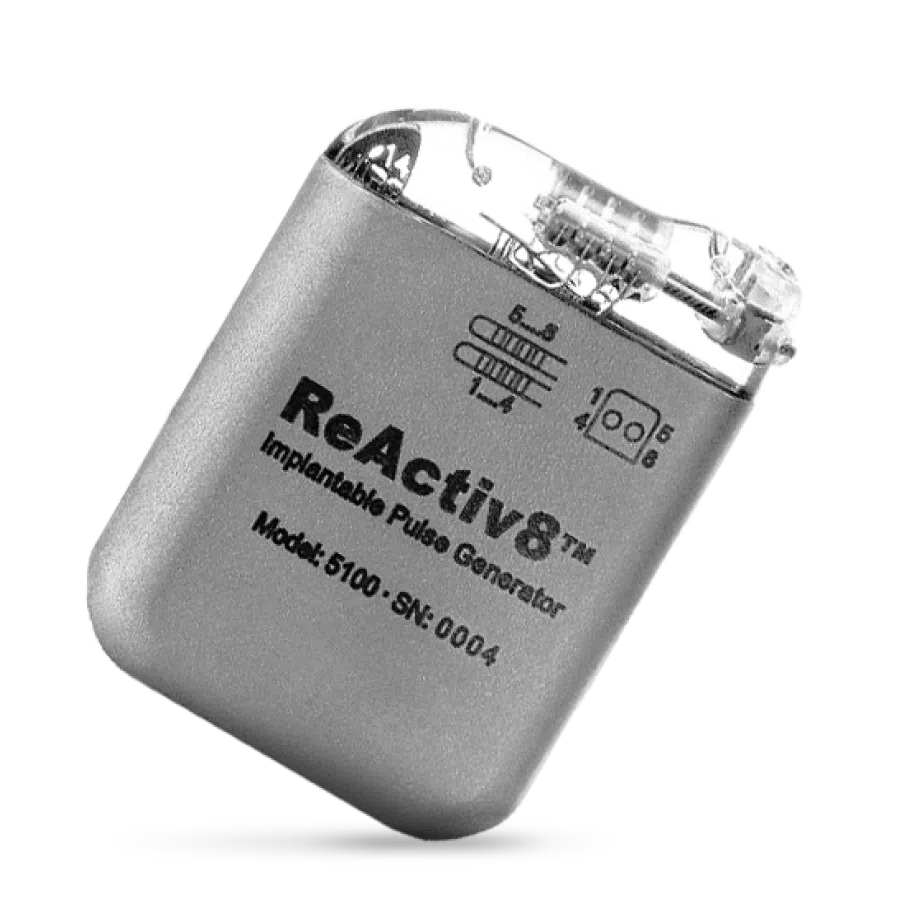
How ReActiv8 works
This is where the device comes in. Instead of placing electrodes on the spinal cord to block pain signaling (which is what spinal cord stimulation does), ReActiv8 places electrodes on the medial branch of the dorsal ramus nerve — the specific nerve that controls the multifidus. The device reaches past the brain’s blockade and forces the muscle to contract.
Patients turn the device on for 30 minutes, once or twice a day, usually while lying on the couch. When you turn it on, you don’t feel a tingling. You feel a contraction — the muscle actually working. Over time, this stimulation overrides the inhibition and teaches the brain that it’s okay to use the muscle again.
In the clinical trials, something unusual happened: over time, patients turned the device on less, not more. They were fixing the underlying problem, not just hiding the symptom. This is fundamentally different from spinal cord stimulation or pain medication, where you typically need the same dose or more over time.
Testimonials
-

- James G.



Why it works at a deeper level
Recent research has revealed something remarkable about what’s happening inside the atrophied multifidus. The problem isn’t just that the muscle is weak. Inside the multifidus, there are tiny sensory organs called muscle spindles that tell your brain where your spine is in space. In chronic back pain, these spindles get encased in fibrosis — internal scar tissue. The sensor is there, but it can’t read the signal. It’s like a thermostat covered in duct tape. The brain stops receiving data, so it loses control of the spine.
You can’t see this fibrosis on an MRI. You can only see the fat. But animal studies now suggest that restorative stimulation actively reverses this fibrosis — it peels the tape off the sensor. This explains why patients feel massive improvement in stability and control even when their MRI still shows a fatty muscle. The picture didn’t change. The sensor that feeds the software got fixed.
Are you ready to meet a leading Orange County Neurosurgeon?
What to expect
ReActiv8 is an outpatient procedure. I implant the electrodes and generator in a single session, and patients go home the same day. The device is activated a few weeks later.
This is important to understand: ReActiv8 is not an instant fix. Unlike spinal cord stimulation, where you can feel pain relief during the trial, ReActiv8 works over months. Patients typically start noticing improvement at 3–6 months as the muscle gradually reactivates and strengthens. Some patients see continued improvement out to a year or more. The expectation that this is a longer-term solution — not a switch you flip — is key. Patients who understand this timeline do better because they stay consistent with the daily sessions.
The daily commitment is real but manageable. Thirty minutes, once or twice a day, lying down with the device on. You’ll feel the multifidus contracting. It’s not painful — most patients describe it as a deep tightening in the low back. Over weeks and months, patients often notice they feel more stable, more confident with movement, and less afraid to be active. The fear of movement — what we call kinesiophobia — starts to dissolve as the spine regains its guardian.
Who is a candidate
ReActiv8 is designed for a specific population: patients with chronic mechanical low back pain associated with multifidus dysfunction who have not responded to conservative treatment. Good candidates typically have:
- Chronic low back pain lasting at least 6 months
- No clear surgical target — meaning the MRI doesn’t show a herniated disc or stenosis that would be fixed by decompression or fusion
- Evidence of multifidus atrophy or dysfunction (often visible as fatty infiltration on MRI)
- Failure of conservative treatments including physical therapy, injections, and medication
- Pain that is primarily mechanical — aggravated by activity and position, centered in the low back
ReActiv8 is not for radicular pain (leg pain from a compressed nerve), and it’s not a replacement for surgery when surgery is indicated. It fills a specific gap: the patient whose back hurts, whose MRI shows muscle atrophy but no structural target, and whose brain has lost the ability to stabilize the spine on its own.

Why this matters to me
This device changed how I think about back pain. Before ReActiv8, I had a toolkit for structural problems — decompressions, fusions, disc replacements — and a toolkit for neuropathic pain — spinal cord stimulation. But for the large population of patients with mechanical low back pain and no surgical target, I had nothing to offer except “do more PT,” knowing full well that generic PT wasn’t going to fix an inhibited muscle the brain couldn’t find.
Now I have a way to address the root cause. Not every patient is a candidate, and not every candidate gets a dramatic result. But when it works — and for many patients it does — you’re watching someone’s spine get its guardian back. That’s a fundamentally different kind of outcome than blocking a pain signal.

Why Choose Dr. Alexander Taghva
Dr. Alexander Taghva is a leading board-certified neurosurgeon, specializing in brain surgery, endoscopic spine surgery, as well as spine disorders. Also, he is the only spine surgeon in Orange County and southern California who offers endoscopic laminotomy surgery. Dr. Taghva:
- Graduated from Johns Hopkins University School of Medicine and completed his residency at the University of California
- Completed a prestigious fellowship at The Ohio State University in Neuromodulation and Functional Neurosurgery
- Specializes in minimally invasive and endoscopic surgery, spinal stenosis, artificial disc replacement, spinal disorders, spinal surgery revision, and other spinal conditions.
- Specializes in brain surgery to treat trigeminal neuralgia, brain tumors, pituitary tumors, and Parkinson’s disease.
- A highly-respected neurosurgeon with many years of experience, including treating chronic pain via stimulation of the spinal cord and brain
- Actively involved in medical research and the lead investigator for clinical trials on spinal cord stimulation